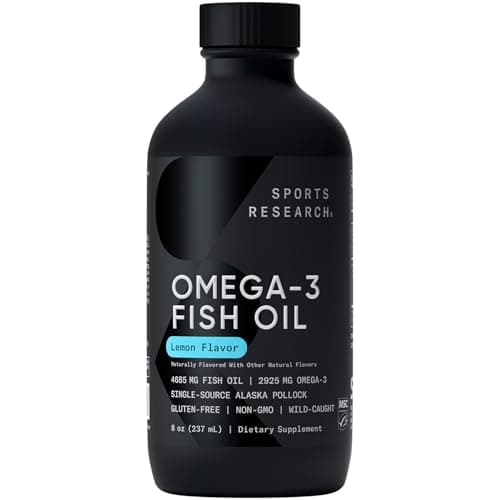
Sports Research Omega-3 Fish Oil Liquid
$5.37 / fluid ounce
Price verified Oct 21, 2026
As an Amazon Associate, we earn from qualifying purchases · Not evaluated by the FDA · Individual results may vary · Consult a healthcare provider before use
Our verdict
1 tablespoon (15mL) per day; flexible dosing possible of Total Omega-3 Fatty Acids as Triglyceride (TG) form — EPA (Eicosapentaenoic Acid) 1,500mg + DHA (Docosahexaenoic Acid) 1,000mg per tablespoon serving…
Why we recommend this
Sports Research Omega-3 Liquid earns a recommendation as a top-tier option for the specific consumer who wants maximum EPA+DHA per serving in a pill-free format. The IFOS 5-Star certification is the most rigorous independent purity standard for fish oil and sets this product apart from the majority of liquid omega-3 products that lack independent verification. The triglyceride form, sustainable Alaska Pollock sourcing, MSC certification, and glass bottle demonstrate a comprehensive quality commitment. For families with members who cannot swallow capsules, the flexible liquid dosing is a genuine advantage over fixed-dose softgels.
Check for interactions
Already taking other supplements or prescription medications? Add them below to check for documented interactions, severity, and clinical guidance.
Our database currently documents 137+ supplement and drug-category interaction pairs. Combinations not flagged here may still interact — always consult your healthcare provider before combining supplements, especially with prescription medications.
What to watch out for
The primary practical limitation of a liquid fish oil is storage and longevity — once opened, omega-3 oils oxidize faster than softgel formats and require refrigeration for optimal freshness. The 8oz glass bottle provides 48 servings, lasting approximately 6–7 weeks at daily use, with a narrower window to consume before oxidation becomes a quality concern. The small review base (100 reviews) also limits confidence in batch-to-batch quality consistency at consumer scale, despite the IFOS 5-Star certification that covers tested batches.
Dose & form
- Serving
- 1 tablespoon (15mL) per day; flexible dosing possible
- Form
- Oil
- Clinical range
- General wellness: 1,000–2,000mg EPA+DHA/day; cardiovascular/anti-inflammatory: 2,000–4,000mg/day; this formula delivers 2,500mg EPA+DHA at full serving — within clinical anti-inflammatory range
- Dose adequacy
- Full
- Supply
- 8 servings · $5.37 / fluid ounce
- UPC
- 023249093084
Who it's best for
Adults who dislike swallowing fish oil capsules, families needing flexible dosing, and those seeking an ultra-potent liquid omega-3 with lemon flavor from a sustainably sourced, IFOS-certified wild-caught source
Who should skip it
Those who prefer capsule or softgel formats, individuals with fish or seafood allergies, strict vegans seeking a plant-based omega-3 alternative, or budget-conscious shoppers
Pros
- IFOS 5-Star certified — the gold standard for omega-3 purity testing, covering heavy metals, PCBs, dioxins, oxidation markers, and potency accuracy
- Triglyceride (TG) form omega-3 — the natural form with superior absorption vs ethyl ester (EE) forms used in many cheaper fish oils
- Glass bottle packaging prevents microplastic leaching and BPA exposure and reduces oxidation risk compared to plastic bottles
- Burpless lemon flavor with no fishy aftertaste, validated through a 10-step low-temperature refinement process
Cons
- Liquid format requires refrigeration after opening and has a shorter shelf life than encapsulated fish oil once opened
- 100 reviews and a 4.5-star rating represent a small review base for drawing conclusions about consistency and long-term product quality
- At $42.95 for 48 servings ($0.89/serving), the price is significantly higher than standard fish oil softgels, though the IFOS certification and glass packaging justify part of the premium
What customers say
4.5★ across 100 Amazon reviews. The most common questions from shoppers: re any potential interactions with medications, re any side effects from long-term use, and cause any digestive issues or side effects. Full answers in the FAQ below.
Frequently Asked Questions
What is the clinical dose for Total Omega-3 Fatty Acids as Triglyceride (TG) form — EPA (Eicosapentaenoic Acid) 1,500mg + DHA (Docosahexaenoic Acid) 1,000mg per tablespoon serving?
What is the clinical dose for Total Omega-3 Fatty Acids as Triglyceride (TG) form — EPA (Eicosapentaenoic Acid) 1,500mg + DHA (Docosahexaenoic Acid) 1,000mg per tablespoon serving?
Clinical trials typically use General wellness: 1,000–2,000mg EPA+DHA/day; cardiovascular/anti-inflammatory: 2,000–4,000mg/day; this formula delivers 2,500mg EPA+DHA at full serving — within clinical anti-inflammatory range. Sports Research Omega-3 Fish Oil Liquid delivers 1 tablespoon (15mL) per day; flexible dosing possible, which we classify as Full relative to that range.
How does Sports Research Omega-3 Fish Oil Liquid compare to similar Oil?
How does Sports Research Omega-3 Fish Oil Liquid compare to similar Oil?
See the "Also consider" section below for two alternatives. Choose based on form preference (Oil vs alternatives), dose adequacy, and third-party testing.
Is Sports Research Omega-3 Fish Oil Liquid third-party tested?
Is Sports Research Omega-3 Fish Oil Liquid third-party tested?
Yes — Third-Party Tested. Third-party testing verifies ingredient identity and label accuracy.
Does this work with Amazon Subscribe & Save?
Does this work with Amazon Subscribe & Save?
Yes — Amazon Subscribe & Save is available for this product. Enrolling locks in a recurring delivery at a reduced per-unit price.
Are there any potential interactions with medications?
Are there any potential interactions with medications?
Omega-3 fatty acids at high doses (3g+ EPA+DHA per day) have mild blood-thinning properties that can potentiate anticoagulants (warfarin, heparin) and antiplatelet drugs (aspirin, clopidogrel). At the 2,500mg EPA+DHA provided by this product's full serving, the interaction risk is low but clinically relevant for surgical patients — most guidelines recommend stopping high-dose omega-3 supplementation 1–2 weeks before surgery. Consult your physician if on blood thinners.
Are there any side effects from long-term use?
Are there any side effects from long-term use?
Long-term omega-3 supplementation at these doses (2,500mg EPA+DHA/day) has an excellent safety record in clinical trials up to 5+ years, including the REDUCE-IT and STRENGTH trials. The primary long-term concern is oxidation of the oil — using an oxidized product is counterproductive, so proper storage and timely use after opening are important. Some studies at very high doses (4g+/day) have noted a small increased risk of atrial fibrillation, though evidence is debated.
Does it cause any digestive issues or side effects?
Does it cause any digestive issues or side effects?
Liquid fish oil is less likely to cause fishy burps than softgels due to the low-temperature refinement and lemon flavoring. A small percentage of users experience loose stools or nausea when starting high-dose omega-3 supplementation — taking it with a meal containing other fats reduces this. Starting with half a tablespoon (7.5mL) for the first week allows gut adaptation before moving to the full serving.
Can it be taken with other supplements or vitamins?
Can it be taken with other supplements or vitamins?
Omega-3 liquid oil pairs well with fat-soluble vitamins (D3, K2, A, E) taken simultaneously — the fat content enhances their absorption. It can be mixed into smoothies, yogurt, or salad dressings. Avoid mixing with iron supplements in the same meal, as omega-3s may slightly reduce iron absorption. There is no interaction with standard vitamin, mineral, or protein supplement regimens at this dose.
Are there any specific instructions for taking it safely?
Are there any specific instructions for taking it safely?
Take 1 tablespoon (15mL) daily, either straight off a spoon or mixed into cold food — do not heat, as oxidation accelerates at cooking temperatures. Refrigerate after opening and use within 60–90 days for optimal freshness. Keep the bottle sealed tightly between uses. Do not use if the oil smells strongly rancid or fishy (fresh fish oil should smell faintly of the sea or lemon, not rotten fish).
How long until benefits are typically experienced?
How long until benefits are typically experienced?
Omega-3 incorporation into cell membranes begins within days of supplementation and reaches steady-state after approximately 4–6 weeks of daily dosing. Anti-inflammatory benefits (joint comfort, exercise recovery) are typically reported after 4–8 weeks of consistent use at EPA+DHA doses above 2,000mg/day. Cardiovascular and triglyceride-lowering effects are measurable at 8–12 weeks in clinical studies using similar doses.