SupplementScience
L-Theanine supplement
Amino Acid / Nootropic

L-Theanine: Benefits, Dosage, Forms & Research

Amino Acid / Nootropic

This content is for informational purposes only and does not constitute medical advice. Consult your healthcare provider before starting any supplement. Full disclaimer

TL;DR — Quick Answer

L-Theanine is a tea-derived amino acid that promotes calm focus by increasing alpha brain waves. At 100-200mg it reduces anxiety without sedation and synergizes powerfully with caffeine for enhanced cognitive performance. The most popular nootropic stack ingredient worldwide.

Key Facts

What it is
A unique amino acid from tea leaves that promotes alpha brain wave activity for calm, focused attention
Primary benefits
  • Promotes calm focus without sedation
  • Increases alpha brain waves
  • Synergizes with caffeine for cognitive performance
  • Reduces anxiety and stress response
  • Supports sleep quality when taken at bedtime
Typical dosage
100-200mg daily
Evidence level
Strong
Safety profile
Generally Safe

What the Research Says

L-Theanine has a robust evidence base, particularly for its synergy with caffeine. Owen et al. (2008) demonstrated that the combination improves attention and task-switching more than either alone. Nobre et al. (2008) used EEG to confirm alpha wave increases within 30 minutes of ingestion. Hidese et al. (2019) found that 200mg/day L-Theanine for 4 weeks reduced stress-related symptoms and improved cognitive function in a randomized placebo-controlled trial. Its excellent safety profile and rapid onset make it one of the most accessible nootropics available.

Benefits of L-Theanine

  • Alpha brain wave induction — L-Theanine increases alpha wave activity (8-13 Hz) within 30-40 minutes of ingestion, producing a state of relaxed alertness similar to meditation (Nobre et al., 2008)
  • Caffeine synergy — the L-Theanine + caffeine combination is the most well-validated nootropic stack, with multiple RCTs showing enhanced attention, task-switching, and reduced caffeine-induced jitteriness (Owen et al., 2008)
  • Anxiety reduction — Kimura et al. (2007) demonstrated that 200mg L-Theanine reduced heart rate and salivary IgA responses to acute stress, indicating physiological anxiety reduction without sedation
  • Sleep quality — 200mg L-Theanine before bed improved sleep quality scores in boys with ADHD (Lyon et al., 2011) and reduced sleep latency in healthy adults without causing next-day drowsiness
  • Neurotransmitter modulation — L-Theanine increases GABA, serotonin, and dopamine levels in the brain while blocking glutamate excitotoxicity, providing a balanced neurochemical environment
Did you know?

L-Theanine has a robust evidence base, particularly for its synergy with caffeine.

Forms of L-Theanine

FormBioavailabilityBest For
Suntheanine CapsulesHighClinically validated — patented, enzymatically produced pure L-isomer form used in most trials
Generic L-Theanine CapsulesHighBudget option — verify pure L-isomer (not D,L-theanine racemic mix)
L-Theanine + Caffeine CapsulesHighConvenience — pre-formulated focus stack, typically 200mg theanine + 100mg caffeine
L-Theanine PowderHighFlexible dosing — can be dissolved in water; has a mild umami taste

Dosage Recommendations

General recommendation: 100-200mg daily; 200mg L-Theanine + 100mg caffeine for focus stack

Timing: As needed; onset within 30-40 minutes; duration 3-5 hours

Dosage by Condition

ConditionRecommended DoseEvidence
Calm focus100-200mg with 50-100mg caffeineStrong
Anxiety reduction200-400mg dailyModerate
Sleep quality200mg 30-60 minutes before bedModerate
Stress resilience200mg before stressful eventsModerate

Upper limit: 400mg/day (generally well-tolerated even at higher doses, but limited data beyond 400mg)

Our Top L-Theanine Pick

Our recommendations are based on published research, not commission rates. Some links below are affiliate links — we may earn a commission at no extra cost to you. How we evaluate products

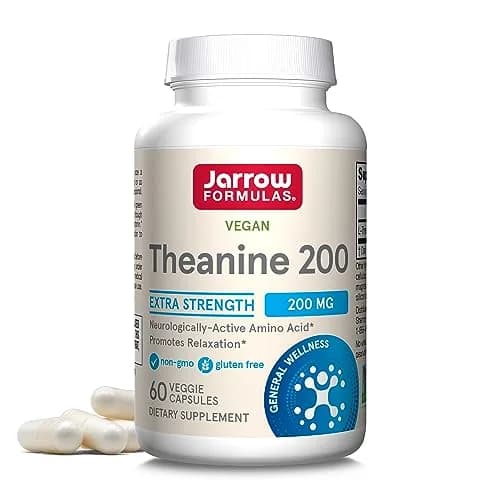
Jarrow Formulas Theanine 200mg

Jarrow Formulas Theanine 200mg

Jarrow Formulas

9.3/10
Overall best L-theanine$0.14/serving

Side Effects and Safety

Safety profile: Generally Safe

Potential Side Effects

  • Exceptionally well-tolerated — one of the safest supplements available
  • Rare: mild headache
  • Rare: dizziness at very high doses
  • No known dependency, tolerance, or withdrawal effects
  • Does not impair cognitive function or cause sedation at normal doses

Drug & Supplement Interactions

  • Blood pressure medications — L-Theanine may mildly lower blood pressure
  • Stimulants — L-Theanine modulates (smooths) stimulant effects without blocking them
  • Sedatives — potential additive relaxation effects, though L-Theanine itself is not sedating
Check L-Theanine interactions with other supplements →
BenefitsDosage GuideSide EffectsTypes & FormsResearchFAQ

Related Conditions

Related Supplements

Frequently Asked Questions

What is the best L-Theanine to caffeine ratio?

The most well-studied ratio is 2:1 (L-Theanine to caffeine). A typical effective dose is 200mg L-Theanine + 100mg caffeine. This ratio provides the cognitive benefits of caffeine (alertness, reaction time) while L-Theanine smooths out the jitters and anxiety. Some people prefer 1:1 for stronger stimulation or 3:1 for a calmer experience.

Can L-Theanine help with sleep?

Yes, but not by causing drowsiness. L-Theanine promotes sleep quality by reducing pre-sleep anxiety and mental chatter through alpha wave induction and GABA modulation. It helps you fall asleep faster by quieting the mind, not by sedating it. Take 200mg 30-60 minutes before bed. Unlike melatonin, it does not affect sleep architecture or cause grogginess.

Is L-Theanine in green tea enough?

A cup of green tea contains approximately 20-30mg of L-Theanine, while clinical studies typically use 100-200mg. You would need 4-10 cups of green tea to reach a therapeutic dose. Supplementation provides a more reliable and concentrated dose without excessive caffeine intake from tea.

References

  1. (). The combined effects of L-theanine and caffeine on cognitive performance and mood. Nutritional Neuroscience. DOI
  2. (). L-theanine, a natural constituent in tea, and its effect on mental state. Asia Pacific Journal of Clinical Nutrition.
  3. (). Effects of L-theanine administration on stress-related symptoms and cognitive functions in healthy adults: a randomized controlled trial. Nutrients. DOI