SupplementScience
Mushroom Coffee supplement
Functional Coffee

Mushroom Coffee: Benefits, Dosage, Forms & Research

Functional Coffee

DJP
Reviewed by , MD, Board Certified Internal Medicine

This content is for informational purposes only and does not constitute medical advice. Consult your healthcare provider before starting any supplement. Full disclaimer

TL;DR — Quick Answer

Mushroom coffee is real coffee blended with medicinal mushroom extracts, offering cognitive focus with roughly half the caffeine of regular coffee. It delivers beta-glucans for immune support and adaptogenic compounds for stress resilience, typically containing 250-1500mg mushroom extract per serving.

Key Facts

  • What it is: A blend of coffee and medicinal mushroom extracts (lion's mane, chaga, reishi, cordyceps)
  • Primary benefits:
    • Cognitive focus without jitters
    • Immune support via beta-glucans
    • Antioxidant activity
    • Reduced caffeine intake
    • Adaptogenic stress support
  • Typical dosage: 1-2 cups daily (250-1500mg mushroom extract per serving)
  • Evidence level: Emerging
  • Safety: Generally Safe

What the Research Says

While mushroom coffee as a specific product category has limited clinical trials, its individual components have substantial research. Hericium erinaceus (lion's mane) has been shown to improve mild cognitive impairment in a 2009 double-blind placebo-controlled trial (Mori et al.). Chaga and reishi have demonstrated immunomodulatory and antioxidant properties in multiple in vitro and animal studies, with emerging human trial data. The reduced caffeine content addresses the well-documented dose-response relationship between caffeine and anxiety/sleep disruption.

Benefits of Mushroom Coffee

  • Cognitive focus without jitters — the combination of reduced caffeine with lion's mane's NGF-stimulating properties provides sustained mental clarity without the crash associated with regular coffee
  • Immune support — beta-glucans from chaga, reishi, and turkey tail activate innate immune cells (macrophages and NK cells), supporting immune surveillance
  • Antioxidant activity — chaga mushroom is one of the highest ORAC-scoring natural substances; combined with coffee's chlorogenic acid, the blend provides potent antioxidant protection
  • Reduced caffeine intake — typically 50-80mg per serving vs 95-200mg in regular coffee, making it suitable for caffeine-sensitive individuals
  • Adaptogenic stress support — reishi and cordyceps modulate the HPA axis, helping the body maintain homeostasis under stress

Forms of Mushroom Coffee

FormBioavailabilityBest For
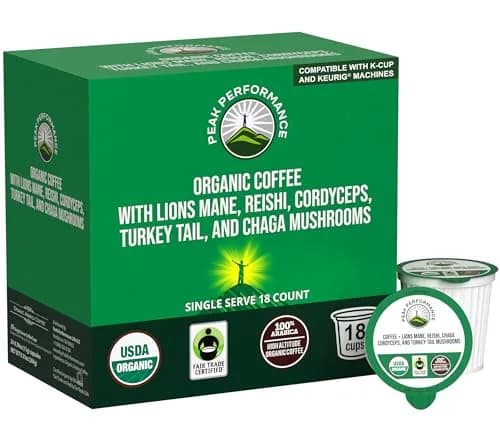
K-Cup PodsModerateConvenience — single-serve brewing with consistent mushroom extract dosing
Ground Coffee BlendModerateTraditional brewing — drip, pour-over, or French press preparation
Whole BeanModerateFreshness — grind before brewing for optimal flavor and potency
Instant PacketsModeratePortability — single-serve sachets for travel and on-the-go use
Concentrate LiquidModerate-HighVersatility — add to hot water, smoothies, or recipes

Dosage Recommendations

General recommendation: 1-2 cups daily (1 pod or 2 tbsp ground per serving); mushroom extract content varies 250-1500mg per serving

Timing: Morning to early afternoon; avoid evening use due to caffeine content

Dosage by Condition

ConditionRecommended DoseEvidence
Cognitive focus1-2 cups daily with lion's mane-dominant blendEmerging
Immune support1-2 cups daily with chaga/turkey tail blendEmerging
Stress management1 cup daily with reishi-dominant blendEmerging
Caffeine reductionReplace 1-2 cups regular coffee with mushroom coffeeModerate

Upper limit: 3 cups daily; monitor total caffeine intake from all sources

Side Effects and Safety

Safety profile: Generally Safe

Potential Side Effects

  • Mild digestive adjustment during first week of use
  • Caffeine sensitivity symptoms (though lower than regular coffee)
  • Possible allergic reaction in individuals sensitive to mushrooms
  • Rare: mild headache during transition from higher-caffeine coffee

Drug & Supplement Interactions

  • Blood thinners (reishi has mild anticoagulant properties)
  • Immunosuppressants (mushroom beta-glucans stimulate immune activity)
  • Diabetes medications (some mushroom extracts may lower blood sugar)
BenefitsDosage GuideSide EffectsTypes & FormsResearchFAQ

Related Conditions

Related Supplements

Looking for the best mushroom coffee supplement?

We analyzed and ranked the top products based on form, dosage, third-party testing, and value.

See Our Top Picks

Frequently Asked Questions

Is mushroom coffee real coffee?

Yes, mushroom coffee is real coffee (Arabica or Robusta beans) blended with powdered medicinal mushroom extracts. It brews and tastes like coffee — not like mushrooms. The mushroom extracts are added for their health-promoting compounds (beta-glucans, hericenones, triterpenes) rather than flavor.

Does mushroom coffee taste like mushrooms?

No. The mushroom extracts used are mild and blend seamlessly with coffee flavor. Most people describe mushroom coffee as having a smooth, slightly earthy taste similar to regular dark roast coffee. The mushroom content is typically 10-20% of the blend by weight.

How much caffeine is in mushroom coffee?

Typically 50-80mg per serving compared to 95-200mg in regular coffee. This roughly 50% reduction comes from replacing a portion of the coffee grounds with mushroom extract powder. The lower caffeine content is a key benefit for those seeking focus without overstimulation.

References

  1. (). Improving effects of the mushroom Yamabushitake (Hericium erinaceus) on mild cognitive impairment: a double-blind placebo-controlled clinical trial. Phytotherapy Research. DOI
  2. (). Therapeutic Potential of Hericium erinaceus for Depressive Disorder. International Journal of Molecular Sciences. DOI
  3. (). Anti-obesity and anti-diabetic effects of compounds from Pleurotus citrinopileatus. World Journal of Diabetes. DOI