SupplementScience
Paraxanthine supplement
Nootropic / Stimulant

Paraxanthine: Benefits, Dosage, Forms & Research

Nootropic / Stimulant

This content is for informational purposes only and does not constitute medical advice. Consult your healthcare provider before starting any supplement. Full disclaimer

TL;DR — Quick Answer

Paraxanthine is caffeine's primary active metabolite, delivering focus and alertness without jitters or anxiety. At 100-200mg it matches the cognitive benefits of 200-400mg caffeine while producing lower cortisol elevation and fewer side effects. A cleaner alternative to caffeine for daily energy.

Key Facts

What it is
The primary active metabolite of caffeine (1,7-dimethylxanthine), responsible for most of caffeine's cognitive effects
Primary benefits
  • Clean mental energy without jitters
  • Enhanced focus and attention
  • No significant cortisol elevation
  • Reduced anxiety compared to caffeine
  • Selective adenosine A2A receptor antagonism
Typical dosage
100-200mg daily
Evidence level
Emerging
Safety profile
Generally Safe

What the Research Says

Paraxanthine research is in its early stages but growing quickly. Yoo et al. (2023) published the first dedicated human trial on pure paraxanthine supplementation, demonstrating improvements in sustained attention and reaction time at 200mg. Xing et al. (2021) characterized paraxanthine's pharmacological profile, showing its selective adenosine A2A antagonism — the mechanism primarily responsible for caffeine's wakefulness-promoting effect — without the broad adrenergic activation that drives caffeine's side effects. The ingredient enfinity (marketed by Ingenious Ingredients) received GRAS status, supporting its safety for commercial use. As a standalone ingredient, paraxanthine is very new; most of what we know comes from decades of caffeine metabolism research where paraxanthine was identified as the principal active metabolite.

Benefits of Paraxanthine

  • Cleaner stimulation — paraxanthine provides wakefulness and focus through selective adenosine A2A receptor antagonism without the broad adrenergic activation that causes caffeine's jitters and anxiety
  • No cortisol spike — unlike caffeine, paraxanthine does not significantly elevate cortisol or epinephrine at standard doses, making it better suited for stress-sensitive individuals
  • Sustained focus — a 2023 study (Yoo et al.) found that 200mg paraxanthine improved sustained attention, reaction time, and working memory compared to placebo over a 6-hour testing window
  • Reduced crash — because paraxanthine has a more predictable metabolism and does not produce the same rebound fatigue pattern as caffeine, users report smoother energy curves
  • Dopamine modulation — paraxanthine enhances dopaminergic signaling more selectively than caffeine, supporting motivation and mood without overstimulation
Did you know?

Paraxanthine research is in its early stages but growing quickly.

Forms of Paraxanthine

FormBioavailabilityBest For
Paraxanthine CapsulesHighPrecise dosing — standard capsules containing 100-200mg of pure paraxanthine
Paraxanthine PowderHighFlexible dosing — can be added to pre-workout or nootropic stacks for customized blends

Dosage Recommendations

General recommendation: 100-200mg once daily in the morning or early afternoon

Timing: Morning or early afternoon; avoid evening use as it still promotes wakefulness

Dosage by Condition

ConditionRecommended DoseEvidence
Focus and alertness100-200mg once dailyEmerging
Pre-workout energy200mg taken 30-45 minutes before exerciseEmerging
Caffeine replacement100mg paraxanthine replaces ~200mg caffeineEmerging

Upper limit: 300mg/day (higher doses have not been adequately studied)

Our Top Paraxanthine Pick

Our recommendations are based on published research, not commission rates. Some links below are affiliate links — we may earn a commission at no extra cost to you. How we evaluate products

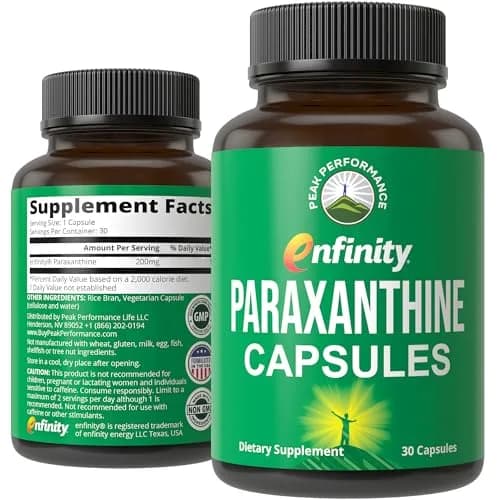
Peak Performance Paraxanthine Capsules

Peak Performance Paraxanthine Capsules

Peak Performance

9/10
Overall — clean energy with straightforward formulation$0.75/serving

Side Effects and Safety

Safety profile: Generally Safe

Potential Side Effects

  • Generally well-tolerated at recommended doses
  • Mild insomnia if taken too late in the day
  • Occasional headache during initial use
  • Less likely than caffeine to cause anxiety, jitters, or heart palpitations

Drug & Supplement Interactions

  • May have additive effects with caffeine and other stimulants — reduce caffeine intake when adding paraxanthine
  • CYP1A2 metabolism — individuals who are slow caffeine metabolizers may also metabolize paraxanthine more slowly
  • Avoid combining with high-dose ephedrine or other sympathomimetics
Check Paraxanthine interactions with other supplements →
BenefitsDosage GuideSide EffectsTypes & FormsResearchFAQ

Related Conditions

Related Supplements

Looking for the best paraxanthine supplement?

We analyzed and ranked the top products based on form, dosage, third-party testing, and value.

See Our Top Picks

Frequently Asked Questions

How is paraxanthine different from caffeine?

When you drink coffee, your liver converts roughly 84% of the caffeine into paraxanthine. This metabolite is actually responsible for most of caffeine's focus and wakefulness benefits. The difference is that pure paraxanthine skips the other metabolites (theobromine and theophylline) that contribute to caffeine's side effects — jitters, anxiety, heart palpitations, and cortisol spikes. Think of paraxanthine as caffeine's signal without the noise.

Can I take paraxanthine with coffee?

You can, but you should reduce your coffee intake accordingly. Since paraxanthine is caffeine's active metabolite, combining them creates additive stimulant effects. A practical approach is to replace one cup of coffee with 100mg of paraxanthine and see how you feel. Many users find they get the same level of alertness with significantly less anxiety.

Is paraxanthine safe?

Paraxanthine has received GRAS (Generally Recognized As Safe) status from an independent expert panel. Your body already produces paraxanthine every time you consume caffeine — it is the most abundant caffeine metabolite in human blood. Dedicated safety studies have found no significant adverse effects at doses up to 300mg. However, as a standalone supplement, long-term studies beyond 8 weeks are still limited.

References

  1. (). Acute paraxanthine ingestion improves cognition and short-term memory and helps sustain attention in a double-blind, placebo-controlled, crossover trial. Nutrients. DOI
  2. (). Dose-response of paraxanthine on cognitive function: a double-blind, placebo-controlled, crossover trial. Nutrients. DOI
  3. (). Pharmacokinetics and metabolism of natural methylxanthines in animal and man. Handbook of Experimental Pharmacology. DOI