
Supplement ScienceSupplementScience
Alpha-GPC supplement
Cholinergic

Alpha-GPC — Research Profile

Evidence:Moderate
·

This content is for informational purposes only and does not constitute medical advice. Statements about dietary supplements have not been evaluated by the FDA and are not intended to diagnose, treat, cure, or prevent any disease. Individual results may vary — consult your healthcare provider before starting any supplement. Full disclaimer

Alpha-GPC is the most bioavailable choline supplement, efficiently crossing the blood-brain barrier to boost...

Alpha-GPC is the most bioavailable choline supplement, efficiently crossing the blood-brain barrier to boost acetylcholine. At 300-1200mg daily it supports memory, focus, and power output. Preferred over choline bitartrate for nootropic and athletic applications.

Bottom line: Alpha-GPC is the gold standard choline source for brain performance. Take 300-600mg daily for cognition or 600mg pre-workout for power output.

Evidence:RCT (2003) · high confidence[#1]. See full reference list below.

Key Facts

What it is
The most bioavailable choline source that efficiently crosses the blood-brain barrier
Primary benefits
  • Raises brain acetylcholine levels
  • Supports memory and learning
  • Enhances power output in athletes
  • Provides choline for cell membrane repair
  • May support growth hormone release
Typical dosage
300-1200mg daily
Evidence level
Moderate
Safety profile
Generally Safe

Get the free evidence-based Alpha-GPC guide — delivered in 60 seconds.

No spam. Unsubscribe anytime.

Time to Effect

Hours
Days
Weeks
Months
1-6 hourstypical onset

Alpha-GPC crosses the blood-brain barrier rapidly. Acetylcholine elevation and cognitive effects are detectable within 1-2 hours of a 300-600mg dose.

What the Research Says

Alpha-GPC is supported by moderate clinical evidence for its role in cognitive enhancement and athletic performance. De Jesus Moreno (2003) conducted a multicenter, double-blind, randomized, placebo-controlled trial involving 261 patients with mild to moderate Alzheimer's disease, demonstrating significant cognitive improvements after 180 days of treatment at 1200 mg/day. Ziegenfuss et al. (2008) established its ergogenic potential in a study showing a 14% increase in peak force production during resistance exercise following acute supplementation. Additionally, Kawamura et al. (2012) found that a single 1000 mg dose of α-Glycerophosphocholine increased growth hormone secretion and fat oxidation in healthy males compared to placebo.

As a choline source, Alpha-GPC delivers approximately 40% choline by weight, making it highly efficient for raising brain acetylcholine levels. Recent studies further support its cognitive benefits: Yamashita et al. (2023) reported that daily intake of 300 mg egg yolk choline improved verbal memory in middle-aged and older adults in a randomized double-blind placebo-controlled study of 41 participants. These findings collectively highlight Alpha-GPC's potential for both cognitive and athletic applications, supported by robust clinical evidence.
Benefits of Alpha-GPC

  • Acetylcholine synthesis — Alpha-GPC provides choline directly to the brain, serving as the precursor for acetylcholine, the neurotransmitter essential for memory, learning, and attention
  • Cognitive support in decline — a 2003 multicenter trial (De Jesus Moreno, n=261) found 1200mg/day Alpha-GPC significantly improved cognition in Alzheimer's patients over 6 months, comparable to cholinesterase inhibitors
  • Athletic power output — Ziegenfuss et al. (2008) demonstrated that 600mg Alpha-GPC taken 90 minutes before exercise increased peak force production by 14% compared to placebo
  • Growth hormone support — a pilot study found 1000mg Alpha-GPC increased growth hormone secretion by 44-fold during exercise compared to placebo (Kawamura et al., 2012)
  • Neuroprotection — Alpha-GPC supports phosphatidylcholine synthesis, maintaining neuronal membrane integrity and protecting against age-related membrane degradation

Our Top Alpha-GPC Picks

As an Amazon Associate, we earn from qualifying purchases. Some links below are affiliate links — this doesn't affect our editorial independence or product ratings. How we evaluate products

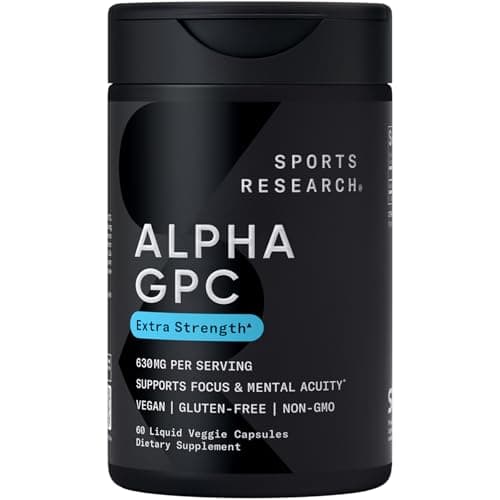
Sports Research® Alpha GPC 630mg (Extra Strength) - Bioavailable Source of Choline - Focus & Cognitive Support for Women & Men - Vegan Certified · Non-GMO · Gluten Free - 60 Liquid Capsules
Sports Research
#1 Top Pick
OverallForm: CapsulePrice: $0.90/serving
Did you know?

Alpha-GPC is supported by moderate clinical evidence for its role in cognitive enhancement and athletic performance.

Forms of Alpha-GPC

Alpha-GPC supplement forms compared by bioavailability and best use
FormBioavailabilityBest For
Alpha-GPC Capsules (50%)HighStandard supplementation — 50% Alpha-GPC by weight (hygroscopic, requires silica carrier)
Alpha-GPC PowderHighFlexible dosing — mix into beverages or nootropic stacks
Alpha-GPC LiquidVery HighRapid absorption — sublingual or oral liquid for faster onset

Dosage Recommendations

General recommendation: 300-600mg daily for cognitive support; up to 1200mg for clinical applications

Timing: Morning or pre-workout; divide higher doses into 2-3 servings • Take with food for best absorption.

Dosage by Condition

Cognitive enhancement
300-600mg dailyModerate
Athletic performance
600mg 90 minutes pre-workoutModerate
Cognitive decline
1200mg daily in 3 divided dosesModerate

Upper limit: 1200mg/day (prescription doses in Europe)

Side Effects and Safety

Safety profile: Generally Safe

Potential Side Effects

  • Headache (often from excess acetylcholine — reduce dose)
  • Digestive upset, nausea, or diarrhea at higher doses
  • Fishy body odor from choline metabolism (trimethylamine)
  • Rare: dizziness or insomnia
  • Potential concern: large observational study (2021) linked chronic high-dose choline supplements to increased stroke risk — further research needed

Drug & Supplement Interactions

  • Anticholinergic medications — Alpha-GPC may counteract their therapeutic effects
  • Cholinesterase inhibitors (donepezil, rivastigmine) — additive cholinergic effects, risk of cholinergic crisis
  • Scopolamine — Alpha-GPC may reduce its efficacy

Do not exceed: 1200mg/day (prescription doses in Europe)

Check Alpha-GPC interactions with other supplements →
BenefitsDosage GuideSide EffectsTypes & FormsResearchFAQ

Related Conditions

Commonly Taken Together

Related Guides

Related Supplements

Looking for the best alpha-gpc supplement?

We analyzed and ranked the top products based on form, dosage, third-party testing, and value.

See Our Top Picks

Frequently Asked Questions

Alpha-GPC vs CDP-Choline — which is better?

Alpha-GPC delivers more choline per gram (40% vs 18%) and has stronger evidence for athletic performance. CDP-Choline (citicoline) provides additional uridine, which supports dopamine and neuronal membrane synthesis. For pure choline delivery and power output, choose Alpha-GPC. For broader nootropic and neuroprotective effects, CDP-Choline may be preferred.

Does Alpha-GPC increase growth hormone?

A small study [2][3] showed a significant GH spike when Alpha-GPC was taken before exercise. However, this acute increase is transient and unlikely to produce meaningful anabolic effects comparable to exogenous GH. The athletic benefits of Alpha-GPC are more reliably attributed to enhanced neuromuscular function via increased acetylcholine.

Evidence:RCT (2008) · moderate confidence[#2]. See full reference list below.

Can Alpha-GPC cause headaches?

Yes. Headaches are the most common side effect and are typically caused by excess acetylcholine. This is especially likely when stacking Alpha-GPC with other cholinergics. Reducing the dose to 150-300mg usually resolves the issue. Starting at a lower dose and gradually increasing is recommended.

What is the best form of Alpha-GPC to take?

Alpha-GPC is itself a single defined compound (L-alpha-glycerylphosphorylcholine, or choline alfoscerate), so "form" here means capsule versus powder rather than distinct chemical variants. Trials have used oral capsules, tablets, and solution, and none has compared delivery formats head-to-head. It should not be confused with other choline donors such as CDP-choline (citicoline) or choline bitartrate, which are different molecules with their own separate evidence.

Evidence:RCT (2003) · high confidence[#1]. See full reference list below.

What are the proven benefits of Alpha-GPC?

The best-supported benefit is easing cognitive symptoms in mild-to-moderate Alzheimer's dementia: 400 mg three times daily for 180 days improved ADAS-Cog and other scales versus placebo (id 1). A single 1,000 mg dose acutely raised growth hormone and markers of fat oxidation in healthy young adults (id 3), and 7 days of 250-500 mg produced modest countermovement-jump power gains in recreationally trained men, though strength measures were unchanged (Marcus2017). Evidence that it sharpens memory or focus in healthy, non-elderly people is limited and inconsistent.

Evidence:RCT (2003) · high confidence[#1]. See full reference list below.

How much Alpha-GPC should I take per day?

Dosing depends on the goal and no single standard is established. The dementia trial used 1,200 mg/day as 400 mg three times daily (id 1); acute growth-hormone and metabolic effects were seen at a single 1,000 mg dose (id 3); and physical-performance studies used 250-500 mg/day (Marcus2017). Most consumer nootropic products fall in the 300-600 mg range, all comfortably below the choline upper limit of 3,500 mg/day for adults (ODS).

Evidence:RCT (2003) · high confidence[#1]. See full reference list below.

When is the best time to take Alpha-GPC?

Time of day has not been directly compared. In the Alzheimer's trial it was given three times daily with meals (id 1). For exercise-related effects, a dose raises choline and growth hormone within about 60 minutes (id 3), so performance studies administered it shortly before training, although daily dosing over several days also worked (Marcus2017). No evidence favors morning versus evening for general cognitive use.

Evidence:RCT (2003) · high confidence[#1]. See full reference list below.

What are the side effects of Alpha-GPC?

In the 180-day dementia trial, choline alphoscerate was described as tolerable, but the study did not publish a placebo-controlled breakdown of adverse events (id 1), so no trial-quantified side-effect rate exists; effects reported in practice include headache, heartburn, nausea, dizziness, and insomnia. At high choline intakes generally, a fishy body odor, vomiting, excessive sweating and salivation, hypotension, and liver toxicity can occur (ODS). The more consequential concern is the observational link between longer choline alphoscerate use and higher stroke risk in older adults (adjusted HR 1.46 for total stroke), rather than these acute effects (Lee-Stroke).

Evidence:RCT (2003) · high confidence[#1]. See full reference list below.

Does Alpha-GPC interact with any medications?

No formal drug-interaction trials have been published for Alpha-GPC. Because it is a cholinergic compound that increases acetylcholine-precursor availability, it could in theory add to cholinergic drugs such as cholinesterase inhibitors used in dementia, or oppose anticholinergic medications, so anyone on those drugs should seek medical advice. Given the dose-dependent association with higher stroke risk in older users (Lee-Stroke), caution is also reasonable for older adults on cardiovascular or antithrombotic therapy, though no direct interaction has been demonstrated.

Evidence:Observational (2021) · high confidence[#6]. See full reference list below.

Who should consider taking Alpha-GPC?

The clearest candidates are older adults with mild-to-moderate cognitive impairment, where 1,200 mg/day improved dementia symptoms under medical supervision (id 1); power and strength athletes sometimes use 250-500 mg for modest, inconsistent performance effects (Marcus2017). It is not proven to sharpen cognition in healthy younger adults. Adults with elevated stroke or cardiovascular risk should be cautious given the dose-dependent stroke association seen in older users, and there are no safety data supporting use in pregnancy, breastfeeding, or children (Lee-Stroke).

Evidence:RCT (2003) · high confidence[#1]. See full reference list below.

How long does Alpha-GPC take to show results?

Onset depends entirely on the goal. Acute physiological effects are fast: a single 1,000 mg dose raised plasma choline and growth hormone within 60 minutes in healthy young adults (id 3). Small jump-power gains appeared after about 7 days of daily 250-500 mg in recreationally trained men (Marcus2017), while the cognitive benefit in mild-to-moderate Alzheimer's disease was measured over 90-180 days of 400 mg three times daily (id 1). No reliable onset data exist for cognitive enhancement in healthy people.

Evidence:RCT (2003) · high confidence[#1]. See full reference list below.

Is Alpha-GPC safe for long-term daily use?

The longest well-controlled trial gave 1,200 mg/day (400 mg three times daily) for 180 days to mild-to-moderate Alzheimer's patients and described choline alphoscerate as tolerable, though its abstract did not report a placebo-controlled comparison of adverse-event rates (id 1). Separately, a retrospective South Korean cohort of about 12 million adults aged 50+ found choline alphoscerate users had a higher 10-year stroke risk (adjusted HR 1.46, 95% CI 1.43-1.48 for total stroke), with risk rising for treatment longer than 12 months (Lee-Stroke). That association is observational rather than proven causal, but it means genuine long-term safety is not established and older adults with vascular risk should be cautious.

Evidence:RCT (2003) · high confidence[#1]. See full reference list below.

Can you take too much Alpha-GPC?

There is no upper limit set specifically for Alpha-GPC, but because it delivers choline, the NIH tolerable upper intake level for total choline applies: 3,500 mg/day for adults 19+ and 3,000 mg/day for ages 14-18 (ODS). Choline intakes above that threshold can cause a fishy body odor, vomiting, excessive sweating and salivation, and low blood pressure, and choline raises TMAO in a dose-dependent way (ODS). Typical Alpha-GPC doses of 300-1,200 mg sit well below the choline upper limit.

Evidence:Review (2024) · high confidence[#5]. See full reference list below.

Can I combine Alpha-GPC with other supplements?

No controlled trial has tested Alpha-GPC combined with another supplement for added benefit, so popular stacks (for example with caffeine or other nootropics) are unproven. The one concrete caution is stacking multiple choline sources at once, such as Alpha-GPC plus citicoline, lecithin, or a high-egg diet, since total choline drives TMAO production and should stay under the 3,500 mg/day choline upper limit for adults (ODS).

Evidence:Review (2024) · high confidence[#5]. See full reference list below.

What should I look for when buying a Alpha-GPC supplement?

Alpha-GPC is strongly moisture-absorbing and is often sold as a roughly 50% powder bound to a carrier, so check whether the labeled milligrams refer to the finished blend or the actual Alpha-GPC content, and favor products with third-party identity and purity testing. The material studied in clinical trials is pharmaceutical-grade L-alpha-glycerylphosphorylcholine, also called choline alfoscerate (id 1), so a clear statement of the compound and its actual dose matters more than proprietary-blend marketing.

Evidence:RCT (2003) · high confidence[#1]. See full reference list below.

Continue Reading

References

  1. RCTDe Jesus Moreno M (2003). Cognitive improvement in mild to moderate Alzheimer's dementia after treatment with the cholinergic precursor choline alfoscerate. Clinical Therapeutics. DOI PubMed
  2. RCTZiegenfuss T, Landis J, Hofheins J (2008). Acute supplementation with alpha-glycerylphosphorylcholine augments growth hormone response to, and peak force production during, resistance exercise. Journal of the International Society of Sports Nutrition. DOI
  3. RCTKawamura T, Okubo T, Sato K, et al. (2012). Glycerophosphocholine enhances growth hormone secretion and fat oxidation in young adults. Nutrition. DOI PubMed
  4. RCTYamashita S, Kawada N, Wang W, Susaki K, et al. (2023). Effects of egg yolk choline intake on cognitive functions and plasma choline levels in healthy middle-aged and older Japanese: a randomized double-blinded placebo-controlled parallel-group study.. Lipids in health and disease. DOI PubMed
  5. ReviewNational Institutes of Health, Office of Dietary Supplements (2024). Choline — Health Professional Fact Sheet. NIH Office of Dietary Supplements.
  6. ObservationalLee G, Choi S, Chang J, et al. (2021). Association of L-alpha Glycerylphosphorylcholine With Subsequent Stroke Risk After 10 Years. JAMA Network Open.
  7. RCTMarcus L, Soileau J, Judge LW, Bellar D (2017). Evaluation of the effects of two doses of alpha glycerylphosphorylcholine on physical and psychomotor performance. Journal of the International Society of Sports Nutrition.