SupplementScience
Phosphatidylserine supplement
Phospholipid

Phosphatidylserine: Benefits, Dosage, Forms & Research

Phospholipid

This content is for informational purposes only and does not constitute medical advice. Consult your healthcare provider before starting any supplement. Full disclaimer

TL;DR — Quick Answer

Phosphatidylserine (PS) is a brain-critical phospholipid shown to improve memory, attention, and cognitive function in aging adults. At 100-300mg daily, it supports neurotransmitter release and cell membrane integrity. The FDA allows a qualified health claim for PS and cognitive decline risk reduction.

Key Facts

What it is
A phospholipid critical for brain cell membrane structure and neurotransmitter release
Primary benefits
  • Supports memory and recall
  • Enhances attention and processing speed
  • May reduce age-related cognitive decline
  • Modulates cortisol response to stress
  • Supports neurotransmitter production
Typical dosage
100-300mg daily
Evidence level
Moderate
Safety profile
Generally Safe

What the Research Says

Phosphatidylserine has a solid evidence base for cognitive support in aging populations. The FDA issued a qualified health claim in 2003 acknowledging that PS may reduce the risk of cognitive dysfunction in the elderly. Kato-Kataoka et al. (2010) demonstrated memory improvements in a 6-month RCT. Earlier bovine-derived PS studies (Crook et al., 1991) showed significant cognitive benefits, and soy-derived PS has been confirmed to have comparable efficacy. Monteleone et al. (1992) established the cortisol-blunting effect that makes PS valuable for stress management.

Benefits of Phosphatidylserine

  • Memory and cognitive function — a 2010 double-blind RCT (Kato-Kataoka et al.) found 100mg/day PS significantly improved memory scores in elderly subjects with mild cognitive complaints over 6 months
  • Attention and processing speed — Baumeister et al. (2008) demonstrated that 400mg/day PS improved cognitive performance during stressful arithmetic tasks in young adults
  • Cortisol modulation — PS supplementation at 600mg/day blunted cortisol response to exercise-induced stress by up to 30% in a controlled trial (Monteleone et al., 1992)
  • Age-related decline prevention — the FDA permits a qualified health claim stating PS may reduce the risk of cognitive dysfunction in the elderly (2003 qualified health claim)
  • Neurotransmitter support — PS facilitates acetylcholine and dopamine release by maintaining optimal cell membrane fluidity in presynaptic neurons
Did you know?

Phosphatidylserine has a solid evidence base for cognitive support in aging populations.

Forms of Phosphatidylserine

FormBioavailabilityBest For
Sunflower-Derived PS CapsulesHighAllergen-free option — soy-free, non-GMO, identical bioactivity to soy PS
Soy-Derived PS CapsulesHighMost studied form — majority of clinical trials used soy-derived PS
PS Complex (with DHA)HighSynergistic formula — PS-DHA conjugates may enhance brain uptake

Dosage Recommendations

General recommendation: 100-300mg daily, divided into 1-3 doses

Timing: With meals for optimal absorption; can split into 2-3 doses • Take with food for best absorption.

Dosage by Condition

ConditionRecommended DoseEvidence
Memory support100-300mg dailyModerate
Cortisol reduction400-600mg dailyModerate
ADHD (adjunct)200mg dailyEmerging

Upper limit: 600mg/day (higher doses not well-studied for long-term use)

Our Top Phosphatidylserine Pick

Our recommendations are based on published research, not commission rates. Some links below are affiliate links — we may earn a commission at no extra cost to you. How we evaluate products

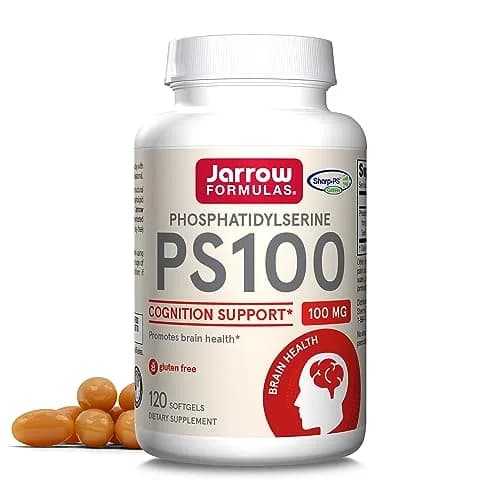
Jarrow Formulas PS 100

Jarrow Formulas PS 100

Jarrow Formulas

9.1/10
Overall best phosphatidylserine for cognitive support$0.25/serving

Side Effects and Safety

Safety profile: Generally Safe

Potential Side Effects

  • Generally well-tolerated at recommended doses
  • Occasional digestive discomfort (nausea, bloating) at higher doses
  • Insomnia if taken late in the evening
  • Rare: headache during initial use

Drug & Supplement Interactions

  • Anticoagulant medications — theoretical concern of enhanced bleeding risk at high doses
  • Anticholinergic drugs — PS may counteract their effects by enhancing cholinergic activity
  • Cholinesterase inhibitors (donepezil) — may have additive cholinergic effects
Check Phosphatidylserine interactions with other supplements →
BenefitsDosage GuideSide EffectsTypes & FormsResearchFAQ

Related Conditions

Related Supplements

Frequently Asked Questions

Is soy or sunflower phosphatidylserine better?

Both forms have identical molecular structures and comparable bioactivity. Soy-derived PS has more clinical trial data behind it, but sunflower-derived PS avoids soy allergen concerns and is non-GMO. Either source is effective at standard doses of 100-300mg daily.

How long does phosphatidylserine take to work?

Most clinical trials show measurable cognitive improvements after 6-12 weeks of consistent daily use. Some users report subtle improvements in focus within 2-4 weeks. For cortisol reduction, effects may be noticed sooner, within 2-3 weeks.

Can phosphatidylserine help with ADHD?

Emerging research suggests PS may benefit children and adults with ADHD. A 2012 study by Hirayama et al. found that PS supplementation improved attention and impulsivity in children with ADHD. However, the evidence is still emerging and PS should not replace standard ADHD treatments without medical guidance.

References

  1. (). Soybean-derived phosphatidylserine improves memory function of the elderly Japanese subjects with memory complaints. Journal of Clinical Biochemistry and Nutrition. DOI
  2. (). Effects of phosphatidylserine on the neuroendocrine response to physical stress in humans. Neuroendocrinology. DOI
  3. (). Influence of phosphatidylserine on cognitive performance and cortical activity after induced stress. Nutritional Neuroscience. DOI