SupplementScience
TUDCA (Tauroursodeoxycholic Acid) supplement
Bile Acid

TUDCA (Tauroursodeoxycholic Acid): Benefits, Dosage, Forms & Research

Bile Acid

This content is for informational purposes only and does not constitute medical advice. Consult your healthcare provider before starting any supplement. Full disclaimer

TL;DR — Quick Answer

TUDCA is a hydrophilic bile acid that protects liver cells by reducing ER stress, improving bile flow, and preventing cell death. Clinical studies confirm it lowers liver enzymes and improves cholestasis. Standard dosing is 250-1500mg daily depending on the condition.

Key Facts

What it is
A taurine-conjugated hydrophilic bile acid with potent hepatoprotective and cytoprotective properties
Primary benefits
  • Reduces endoplasmic reticulum (ER) stress
  • Improves bile flow and prevents cholestasis
  • Protects hepatocytes from apoptosis
  • May improve insulin sensitivity and metabolic markers
Typical dosage
250-1500mg daily
Evidence level
Moderate
Safety profile
Generally Safe

What the Research Says

TUDCA has a robust evidence base as both a pharmaceutical and supplement. Pan et al. (2013) conducted a multicenter RCT showing TUDCA at 750mg/day significantly improved biochemical markers in primary biliary cholangitis patients. Rodrigues et al. (1998) established the mechanistic basis for TUDCA's cytoprotective effects through mitochondrial membrane stabilization and apoptosis inhibition. Ozcan et al. (2006) published a landmark paper in Science demonstrating that TUDCA resolves ER stress and improves insulin signaling, opening a new therapeutic avenue for metabolic diseases. Kars et al. (2010) translated these findings to humans, showing improved insulin sensitivity in obese subjects. TUDCA's dual role as both a bile acid and chemical chaperone makes it uniquely versatile among hepatoprotective agents.
Benefits of TUDCA (Tauroursodeoxycholic Acid)

  • ER stress reduction — TUDCA acts as a chemical chaperone that stabilizes protein folding in the endoplasmic reticulum, preventing the unfolded protein response (UPR) that triggers hepatocyte apoptosis. Ozcan et al. (2006, mouse model) demonstrated TUDCA normalized ER stress markers and improved insulin signaling.
  • Cholestasis improvement — a multicenter RCT by Pan et al. (2013, n=199) showed TUDCA at 750mg/day significantly reduced bilirubin, ALT, AST, and GGT in patients with primary biliary cholangitis over 6 months.
  • Hepatocyte protection — TUDCA stabilizes mitochondrial membranes and prevents cytochrome c release, inhibiting the intrinsic apoptosis pathway. Rodrigues et al. (1998) demonstrated this anti-apoptotic mechanism in multiple liver disease models.
  • Bile flow enhancement — as a hydrophilic bile acid, TUDCA displaces toxic hydrophobic bile acids (like lithocholic acid) from hepatocyte membranes, reducing their cytotoxic effects and improving overall bile composition.
  • Metabolic benefits — Kars et al. (2010, n=20) showed TUDCA at 1750mg/day for 4 weeks improved insulin sensitivity by approximately 30% in obese subjects, mediated through ER stress reduction in liver and muscle tissue.
Did you know?

TUDCA has a robust evidence base as both a pharmaceutical and supplement.

Forms of TUDCA (Tauroursodeoxycholic Acid)

FormBioavailabilityBest For
TUDCA CapsulesModerate-High (oral bioavailability ~60%)Standard supplementation — well-absorbed orally with good hepatic first-pass uptake
UDCA (Ursodeoxycholic Acid)ModeratePharmaceutical alternative — FDA-approved for primary biliary cholangitis; requires hepatic conjugation with taurine

Dosage Recommendations

General recommendation: 250-500mg daily for general liver support

Timing: Take with meals, divided into 2-3 doses for higher dosages • Take with food for best absorption.

Dosage by Condition

ConditionRecommended DoseEvidence
General liver protection250-500mg dailyModerate
Cholestatic liver disease750-1500mg dailyStrong
Steroid/prohormone liver support500-1000mg dailyEmerging
Metabolic/insulin resistance support1500-1750mg dailyEmerging

Upper limit: 1750mg/day (used in clinical trials without serious adverse effects)

Our Top TUDCA (Tauroursodeoxycholic Acid) Pick

Our recommendations are based on published research, not commission rates. Some links below are affiliate links — we may earn a commission at no extra cost to you. How we evaluate products

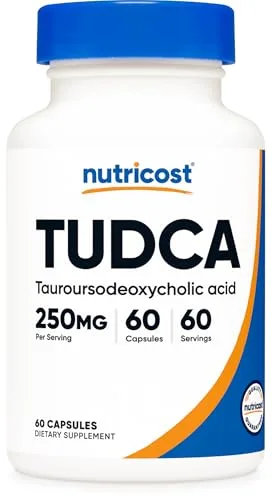
Nutricost TUDCA 250mg

Nutricost TUDCA 250mg

Nutricost

8.8/10
Best value TUDCA at the standard support dose$0.33/serving

Side Effects and Safety

Safety profile: Generally Safe

Potential Side Effects

  • Mild diarrhea (most common, especially at higher doses)
  • Nausea or stomach discomfort
  • Rare: constipation or flatulence
  • Very rare: allergic skin reactions

Drug & Supplement Interactions

  • May reduce absorption of cyclosporine — separate by 2 hours
  • Bile acid sequestrants (cholestyramine, colestipol) reduce TUDCA absorption — separate by 4 hours
  • May potentiate effects of other hepatoprotective agents
  • Aluminum-containing antacids may reduce absorption
Check TUDCA (Tauroursodeoxycholic Acid) interactions with other supplements →
BenefitsDosage GuideSide EffectsTypes & FormsResearchFAQ

Related Conditions

Related Supplements

Frequently Asked Questions

What is the difference between TUDCA and UDCA?

TUDCA is UDCA conjugated with the amino acid taurine. This conjugation makes TUDCA more water-soluble and potentially more effective at displacing toxic bile acids. UDCA (ursodiol) is the FDA-approved pharmaceutical for primary biliary cholangitis, while TUDCA is available as a supplement. Both are effective, but TUDCA may have superior cytoprotective properties due to its additional ER stress-reducing effects.

Is TUDCA safe to take with oral steroids or prohormones?

TUDCA is widely used in the bodybuilding community during oral steroid cycles to protect the liver, and its mechanism of action (bile flow improvement, ER stress reduction) is relevant to methylated steroid-induced cholestasis. While no RCTs have specifically studied this use, the pharmacological rationale is sound. Typical doses of 500-1000mg daily are used. However, the safest approach is to avoid hepatotoxic substances altogether.

Can TUDCA help with gallbladder issues?

TUDCA and its parent compound UDCA can help dissolve cholesterol gallstones and improve bile composition. UDCA is FDA-approved for this purpose. TUDCA may also help prevent gallstone formation by improving bile flow and altering bile acid composition to be more hydrophilic. If you have gallbladder disease, consult your physician before supplementing.

References

  1. (). Efficacy and safety of tauroursodeoxycholic acid in the treatment of liver cirrhosis: A double-blind randomized controlled trial. Journal of Huazhong University of Science and Technology - Medical Sciences. DOI
  2. (). Chemical chaperones reduce ER stress and restore glucose homeostasis in a mouse model of type 2 diabetes. Science. DOI
  3. (). A novel role for ursodeoxycholic acid in inhibiting apoptosis by modulating mitochondrial membrane perturbation. Journal of Clinical Investigation. DOI
  4. (). Tauroursodeoxycholic acid may improve liver and muscle but not adipose tissue insulin sensitivity in obese men and women. Diabetes. DOI