SupplementScience
Quercetin supplement
Bioflavonoid

Quercetin: Benefits, Dosage, Forms & Research

Bioflavonoid

This content is for informational purposes only and does not constitute medical advice. Consult your healthcare provider before starting any supplement. Full disclaimer

TL;DR — Quick Answer

Quercetin is a plant flavonoid with anti-inflammatory, immune-modulating, and senolytic properties. The phytosome form absorbs up to 20x better than standard quercetin. Typical doses are 500-1000mg daily (or 250-500mg as phytosome). It is commonly paired with vitamin C or bromelain to further enhance absorption and effects.

Key Facts

What it is
A plant-derived bioflavonoid with anti-inflammatory, antioxidant, and senolytic activity
Primary benefits
  • Powerful anti-inflammatory (inhibits NF-kB and COX-2)
  • Senolytic activity — clears senescent cells
  • Immune system modulation
  • Antioxidant protection
  • Supports cardiovascular health
Typical dosage
500-1000mg daily (standard) or 250-500mg daily (phytosome)
Evidence level
Moderate
Safety profile
Generally Safe

What the Research Says

Quercetin has a deep evidence base as a dietary flavonoid with pharmacological activity. Its senolytic potential is the most exciting frontier — the quercetin + dasatinib combination pioneered by Mayo Clinic researchers (Kirkland & Tchkonia, 2020) has entered multiple clinical trials for aging-related diseases. Serban et al. (2016) conducted a comprehensive meta-analysis confirming blood pressure-lowering effects. The phytosome delivery system (Quercefit by Indena) has resolved quercetin's historically poor bioavailability, with Riva et al. (2019) demonstrating up to 20-fold improved plasma concentrations compared to standard quercetin. For immune function, Li et al. (2016) reviewed quercetin's mast cell stabilizing and cytokine-modulating effects.

Benefits of Quercetin

  • Senolytic activity — quercetin combined with dasatinib is the most studied senolytic cocktail in clinical research; a 2019 pilot trial (Justice et al.) demonstrated clearance of senescent cells in patients with diabetic kidney disease, reducing inflammatory markers
  • Immune modulation — quercetin stabilizes mast cells and reduces histamine release, which may help manage allergic responses; a 2016 review found quercetin inhibited pro-inflammatory cytokines IL-6, IL-8, and TNF-alpha
  • Anti-inflammatory — quercetin inhibits NF-kB and COX-2 pathways, two central drivers of chronic inflammation, with effects demonstrated in both cell culture and human supplementation trials
  • Cardiovascular support — a meta-analysis of 7 RCTs (Serban et al., 2016) found quercetin supplementation significantly reduced systolic blood pressure by 3.04 mmHg in hypertensive individuals
  • Enhanced bioavailability via phytosome — quercetin phytosome (Quercefit) achieves up to 20x greater plasma levels than standard quercetin dihydrate, meaning lower doses produce stronger effects
Did you know?

Quercetin has a deep evidence base as a dietary flavonoid with pharmacological activity.

Forms of Quercetin

FormBioavailabilityBest For
Quercetin Phytosome (Quercefit)Very High (up to 20x standard)Maximum absorption — phospholipid-bound quercetin for dramatically improved bioavailability at lower doses
Quercetin DihydrateLowBudget option — the standard form used in most supplements, though absorption is poor without enhancement
Quercetin with BromelainModerateAnti-inflammatory support — bromelain (pineapple enzyme) enhances quercetin absorption and adds its own anti-inflammatory effects
Quercetin + Vitamin CModerateImmune support — vitamin C regenerates oxidized quercetin and provides synergistic antioxidant benefits

Dosage Recommendations

General recommendation: 500-1000mg daily (standard quercetin) or 250-500mg daily (phytosome form)

Timing: With meals containing fat to improve absorption; phytosome forms can be taken without food • Take with food for best absorption.

Dosage by Condition

ConditionRecommended DoseEvidence
Anti-inflammatory / immune support500-1000mg daily with mealsModerate
Senolytic protocol1000-1250mg intermittently (consult practitioner)Emerging
Blood pressure support500mg dailyModerate
Allergy support500-1000mg daily, starting 2-4 weeks before allergy seasonEmerging

Upper limit: 1500mg/day (higher doses may cause GI discomfort and headache)

Our Top Quercetin Pick

Our recommendations are based on published research, not commission rates. Some links below are affiliate links — we may earn a commission at no extra cost to you. How we evaluate products

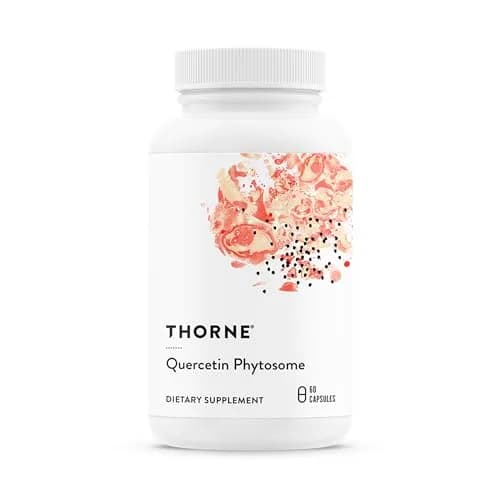
Thorne Quercetin Phytosome

Thorne Quercetin Phytosome

Thorne

9.4/10
Overall — best absorption via phytosome technology with NSF certification$0.52/serving

Side Effects and Safety

Safety profile: Generally Safe

Potential Side Effects

  • Generally well-tolerated at recommended doses
  • GI discomfort (nausea, stomach cramps) at higher doses
  • Headache reported by some users, particularly at doses above 1000mg
  • May cause tingling or numbness in extremities in rare cases

Drug & Supplement Interactions

  • Cyclosporine — quercetin may increase blood levels of cyclosporine by inhibiting CYP3A4
  • Blood thinners (warfarin, aspirin) — quercetin has mild antiplatelet activity and may enhance anticoagulant effects
  • Fluoroquinolone antibiotics — quercetin may interfere with their antibacterial activity
  • Quercetin may interact with medications metabolized by CYP3A4, CYP1A2, and CYP2C9 enzymes
Check Quercetin interactions with other supplements →
BenefitsDosage GuideSide EffectsTypes & FormsResearchFAQ

Related Conditions

Related Supplements

Looking for the best quercetin supplement?

We analyzed and ranked the top products based on form, dosage, third-party testing, and value.

See Our Top Picks

Frequently Asked Questions

Is quercetin phytosome worth the extra cost?

Yes, for most people. Standard quercetin has notoriously poor absorption — only about 2% of an oral dose reaches the bloodstream. Quercetin phytosome achieves up to 20x higher plasma levels, meaning a 250mg phytosome dose delivers more active quercetin than 1000mg of standard quercetin dihydrate. Despite costing more per capsule, phytosome is actually more cost-effective per unit of absorbed quercetin.

Can quercetin help with allergies?

Quercetin stabilizes mast cells and reduces histamine release, which are central mechanisms in allergic reactions. While it is not as fast-acting as antihistamine medications, several studies show that consistent quercetin supplementation (500-1000mg daily) can reduce allergy symptoms over 2-4 weeks. Starting supplementation before allergy season may provide the best results. Quercetin with vitamin C provides synergistic support for seasonal allergies.

What are senolytic supplements?

Senolytics are compounds that selectively eliminate senescent cells — damaged cells that stop dividing but refuse to die and instead release inflammatory signals (the "senescence-associated secretory phenotype" or SASP). Quercetin combined with dasatinib is the most studied senolytic cocktail. On its own, quercetin has modest senolytic effects, primarily in specific cell types. True senolytic protocols typically use intermittent high doses rather than daily supplementation.

References

  1. (). Senolytics in idiopathic pulmonary fibrosis: Results from a first-in-human, open-label, pilot study. EBioMedicine. DOI
  2. (). Effects of quercetin on blood pressure: a systematic review and meta-analysis of randomized controlled trials. Journal of the American Heart Association. DOI
  3. (). Improved oral absorption of quercetin from quercetin Phytosome, a new delivery system based on food grade lecithin. European Journal of Drug Metabolism and Pharmacokinetics. DOI