
We evaluated pediatric probiotic supplements across strain diversity, clinical evidence in children, age-appropriate delivery formats, safety profiles, and value. Our recommendations prioritize products with strains studied specifically in pediatric populations and delivery systems designed for children.
Best Probiotics for Kids (2026)
Product pricing and availability checked
Methodology: Evidence-ranked evaluation
·
2,600+Clinical Studies Cited
·3Probiotics products evaluated
This content is for informational purposes only and does not constitute medical advice. Statements about dietary supplements have not been evaluated by the FDA and are not intended to diagnose, treat, cure, or prevent any disease. Individual results may vary — consult your healthcare provider before starting any supplement. Full disclaimer
As an Amazon Associate, we earn from qualifying purchases. Some links below are affiliate links — this doesn't affect our editorial independence or product ratings. How we evaluate products
Our Verdict
The best kids' probiotic delivers clinically studied strains in an age-appropriate format with pediatric safety data and no added sugar.
Best By Category
The best probiotic for kids combines multiple clinically studied strains in a child-friendly format with no added sugar.
The best probiotic for kids combines multiple clinically studied strains in a child-friendly format with no added sugar. Look for products with strains tested in pediatric trials, age-appropriate dosing, and third-party testing to verify potency.
How We Chose These Products
Products are ranked using our published scoring methodology — evidence strength, dose adequacy, ingredient form, third-party testing signals, value, and clean-label factors are weighted across the 5 criteria below. Commercial relationships do not determine our editorial rankings.
Pediatric Strain Evidence
30%Strains with published clinical trials in pediatric populations score highest. Named strain designations (genus, species, strain) with documented safety in children aged 3-17 are prioritized over generic blends.
Age-Appropriate Delivery
25%Children's probiotics must be easy to administer. Chewable tablets, powders that mix into food, and gummies (ideally without excessive sugar) are evaluated for palatability and compliance.
Safety Profile
20%Pediatric safety is paramount. Products must be free from unnecessary additives, artificial colors, and excessive sugar. Allergen transparency and age-appropriate labeling are required.
Third-Party Testing
15%Independent verification of CFU counts at expiration (not manufacture), contaminant screening, and label accuracy. Especially important for children's supplements where dosing precision matters.
Value
10%Cost per serving relative to strain quality, CFU count, and delivery format. Children's probiotics are a long-term commitment, so sustainable pricing matters for family budgets.
#1 Top Pick
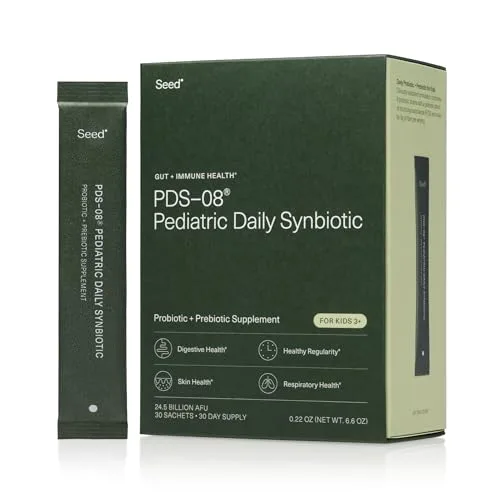
Combines 9 clinically studied probiotic strains with 5g of prebiotic fiber in a single tasteless powder sachet designed for ages 3-17. The synbiotic approach (probiotics + prebiotics together) supports both introducing beneficial bacteria and feeding them. No sugar, no artificial flavors, and the powder format mixes invisibly into food or drinks.
Ingredient9 Probiotic Strains + 5g Prebiotic Fiber
Dose9 strains + 5g fiber per sachet
FormPowder Sachets
TestingThird-Party Tested, Vegan, Shelf-Stable
9 strains + 5g fiber per sachetClinical range: 10-50 billion CFU daily (strain-specific)
Blend formula
$6.06 / ounce$39.99 · 30 Sachets
Pros
- 9 clinically studied probiotic strains
- Includes 5g prebiotic fiber (synbiotic)
- Tasteless powder mixes into any food or drink
Cons
- Premium price ($39.99/month)
- Requires mixing — not a grab-and-go format
Quick Comparison
#1Seed PDS-08 Pediatric Daily Synbiotic
9/10
Seed
#1 Top Pick
260 Amazon reviews
Best for: Comprehensive pediatric gut support with prebiotics and probiotics in one
9 Probiotic Strains + 5g Prebiotic Fiber · 9 strains + 5g fiber per sachet
Powder Sachets · Third-Party Tested, Vegan, Shelf-Stable
$39.99
$6.06 / ounce
#2Florastor Kids Daily Probiotic
8.5/10
Florastor
6,841 Amazon reviews
Best for: Antibiotic-associated diarrhea prevention and yeast-based probiotic support
Saccharomyces boulardii CNCM I-745 · 250mg (5 billion CFU) per packet
Powder Packets · Third-Party Tested
$22.99
$1.15 / count
#3Garden of Life Dr. Formulated Probiotics Organic Kids+
8.3/10
Garden of Life
9,876 Amazon reviews
Best for: Organic, multi-strain chewable for kids who prefer tablets over powders
14 Probiotic Strains (Lactobacillus & Bifidobacterium) · 5 billion CFU per chewable tablet
Chewable Tablets · Third-Party Tested, Non-GMO Project Verified, USDA Organic
$18.49
$0.62 / count
| # | Product | Best For | Ingredient & Dose | Form & Testing | Price | Rating | |
|---|---|---|---|---|---|---|---|
| 1 | Seed PDS-08 Pediatric Daily Synbiotic #1 Top Pick 260 Amazon reviews | Comprehensive pediatric gut support with prebiotics and probiotics in one | 9 Probiotic Strains + 5g Prebiotic Fiber 9 strains + 5g fiber per sachet | Powder Sachets 30 Sachets Third-Party Tested, Vegan, Shelf-Stable | $39.99 $6.06 / ounce | 9/10 | |
| 2 | Florastor Kids Daily Probiotic 6,841 Amazon reviews | Antibiotic-associated diarrhea prevention and yeast-based probiotic support | Saccharomyces boulardii CNCM I-745 250mg (5 billion CFU) per packet | Powder Packets 20 Powder Sticks Third-Party Tested | $22.99 $1.15 / count | 8.5/10 | |
| 3 | Garden of Life Dr. Formulated Probiotics Organic Kids+ 9,876 Amazon reviews | Organic, multi-strain chewable for kids who prefer tablets over powders | 14 Probiotic Strains (Lactobacillus & Bifidobacterium) 5 billion CFU per chewable tablet | Chewable Tablets 30 Chewables Third-Party Tested, Non-GMO Project Verified, USDA Organic | $18.49 $0.62 / count | 8.3/10 |
Detailed Reviews
#1 Top Pick
Seed PDS-08 Pediatric Daily Synbiotic - Fiber-Based Prebiotic & Probiotic for Kids - Digestive Health, Regularity, Constipation Relief - Ages 3-17 - Vegan and Shelf-Stable - 30 Sachets (30-Day Supply)
Seed
260 Amazon reviews
9/10
(260)
Combines 9 clinically studied probiotic strains with 5g of prebiotic fiber in a single tasteless powder sachet designed for ages 3-17. The synbiotic approach (probiotics + prebiotics together) supports both introducing beneficial bacteria and feeding them. No sugar, no artificial flavors, and the powder format mixes invisibly into food or drinks.
Ingredient9 Probiotic Strains + 5g Prebiotic Fiber
Dose9 strains + 5g fiber per sachet
FormPowder Sachets
TestingThird-Party Tested, Vegan, Shelf-Stable
9 strains + 5g fiber per sachetClinical range: 10-50 billion CFU daily (strain-specific)
Blend formula
$6.06 / ounce$39.99 · 30 Sachets
Ideal for: Comprehensive pediatric gut support with prebiotics and probiotics in one
Not ideal for: Families on a tight budget or children who resist mixing powders into food
Pros
- 9 clinically studied probiotic strains
- Includes 5g prebiotic fiber (synbiotic)
- Tasteless powder mixes into any food or drink
- No sugar, no artificial colors or flavors
Cons
- Premium price ($39.99/month)
- Requires mixing — not a grab-and-go format
- Newer product vs established kids' brands
Florastor Kids Dual Action Probiotic Supplement, Strengthens Kids' Digestive & Immune Health, 20 Easy-to Mix Powder Sticks, Packaging May Vary
Florastor
6,841 Amazon reviews
8.5/10
(6,841)
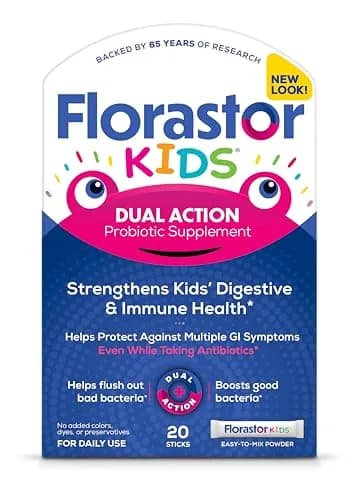
Uses Saccharomyces boulardii CNCM I-745, a unique probiotic yeast that is naturally antibiotic-resistant — meaning it can be taken alongside antibiotics without being destroyed. Over 100 clinical studies support S. boulardii for preventing antibiotic-associated diarrhea in children. Tutti-frutti flavor appeals to kids.
IngredientSaccharomyces boulardii CNCM I-745
Dose250mg (5 billion CFU) per packet
FormPowder Packets
TestingThird-Party Tested
250mg (5 billion CFU) per packetClinical range: 10-50 billion CFU daily (strain-specific)
Blend formula
$1.15 / count$22.99 · 20 Powder Sticks
Ideal for: Antibiotic-associated diarrhea prevention and yeast-based probiotic support
Not ideal for: Children with yeast allergies or those seeking Lactobacillus-based strains
Pros
- Antibiotic-resistant yeast probiotic
- 100+ clinical studies on S. boulardii
- Can be taken during antibiotic courses
- Tutti-frutti flavor kids enjoy
Cons
- Single yeast strain — no bacterial diversity
- Contains fructose in flavoring
- Not suitable for yeast-allergic children
Garden of Life Dr. Formulated Probiotics Organic Kids+ plus Vitamin C & D - Berry Cherry - Gluten, Dairy & Soy Free Immune & Digestive Health Supplement, No Added Sugar, 30 Chewables (Shelf Stable)
Garden of Life
9,876 Amazon reviews
8.3/10
(9,876)
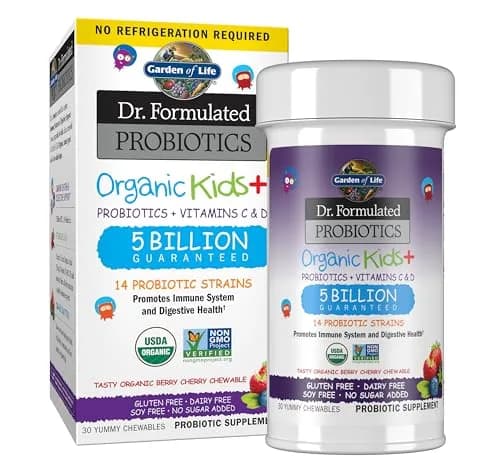
Delivers 14 diverse probiotic strains in a USDA Organic chewable tablet with a kid-friendly berry cherry flavor. Includes prebiotic fiber from organic acacia and potato starch. Formulated by neurologist Dr. David Perlmutter specifically for children's digestive and immune health. Shelf-stable, no refrigeration needed.
Ingredient14 Probiotic Strains (Lactobacillus & Bifidobacterium)
Dose5 billion CFU per chewable tablet
FormChewable Tablets
TestingThird-Party Tested, Non-GMO Project Verified, USDA Organic
5 billion CFU per chewable tabletClinical range: 10-50 billion CFU daily (strain-specific)
Blend formula
$0.62 / count$18.49 · 30 Chewables
Ideal for: Organic, multi-strain chewable for kids who prefer tablets over powders
Not ideal for: Children who need higher CFU counts or parents who want sugar-free options
Pros
- 14 diverse Lactobacillus & Bifidobacterium strains
- USDA Organic and Non-GMO Project Verified
- Includes prebiotic fiber
- Berry cherry flavor kids enjoy
Cons
- Contains organic cane sugar
- 5 billion CFU — lower than some competitors
- Tablet size may challenge younger children
Pairs Well With
Frequently taken together based on complementary benefits
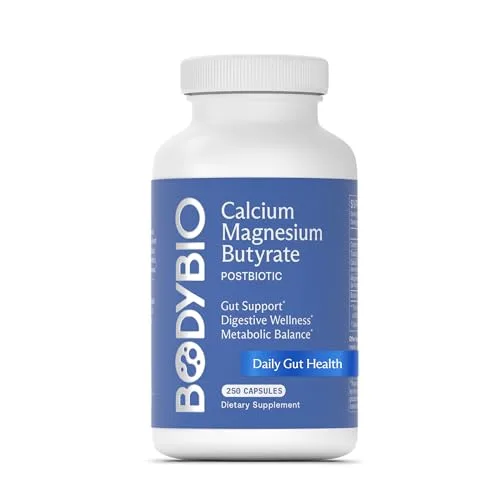
Tributyrin
BodyBio Butyrate
600mg butyrate (as calcium/magnesium salt)
How to Choose
Prioritize Pediatric-Studied Strains
Not all probiotic strains are interchangeable. Lactobacillus rhamnosus GG (LGG) has the most extensive pediatric research, with over 200 published studies in children. Saccharomyces boulardii is well-studied for preventing antibiotic-associated diarrhea. Multi-strain formulas may offer broader support, but ensure each strain has at least some clinical backing in pediatric populations rather than relying solely on adult data.
Delivery Format and Compliance
The best probiotic is one your child will actually take consistently. Tasteless powders that mix into food work well for picky eaters. Chewable tablets suit older children who can handle the texture. Gummies are popular but often contain 2-4g of added sugar per serving. Avoid capsules for young children due to choking risk — powder or chewable formats are safer for ages 3-12.
Safety Considerations for Children
Probiotics are generally safe for healthy children over age 3, but consult a pediatrician for children with weakened immune systems, short gut syndrome, or central venous catheters. Start with a lower CFU count and increase gradually to minimize initial gas or bloating. Store products according to label instructions to maintain potency. Check for common allergens — some probiotics contain traces of milk, soy, or gluten from their growth media.
Ready to Buy?
Seed PDS-08 Pediatric Daily Synbiotic
9/10$6.06 / ounceBest for: Comprehensive pediatric gut support with prebiotics and probiotics in one
The best kids' probiotic delivers clinically studied strains in an age-appropriate format with pediatric safety data and no added sugar.
Evidence:Meta-analysis (2019) · 33 RCTs · n=6,352 · high confidence[#2]. See full reference list below.Read Our Full Probiotics Research Guide
Evidence level, dosage, side effects, and more →
Already taking supplements?
Check how Probiotics fits with your current stack — interactions, timing, and optimization →
Related Supplements
Related Conditions
Learn More
Frequently Asked Questions
What is the best probiotic for kids?
What is the best probiotic for kids?
Seed PDS-08 Pediatric Daily Synbiotic is our top pick for its 9 clinically studied strains plus 5g prebiotic fiber in a tasteless, sugar-free powder format for ages 3-17. For a budget-friendly option, Garden of Life Dr. Formulated Probiotics Organic Kids+ at $0.52/serving delivers 5 billion CFU across 14 strains in a chewable tablet format.
Are probiotics safe for children?
Are probiotics safe for children?
Probiotics are generally considered safe for healthy children over age 3. A 2019 Cochrane meta-analysis of 33 trials (6,352 children) found that probiotic supplementation was not associated with serious adverse events [2]. Clinical practice guidelines from the European Paediatric Association confirm efficacy across selected pediatric conditions while advising caution in immunocompromised children [1]. Consult your pediatrician before starting probiotics for children with compromised immune systems, chronic illness, or those under age 3.
Evidence:Meta-analysis (2019) · 33 RCTs · n=6,352 · high confidence[#2]. See full reference list below.How many CFU should a kids' probiotic have?
How many CFU should a kids' probiotic have?
Most pediatric probiotic studies use 1-10 billion CFU per day. Higher is not necessarily better for children — strain selection and clinical evidence matter more than raw CFU count. A product with 5 billion CFU of a well-studied strain like LGG is preferable to 50 billion CFU of unstudied strains.
Can kids take probiotics with antibiotics?
Can kids take probiotics with antibiotics?
Yes, and research supports doing so. A Cochrane review found that probiotics reduced antibiotic-associated diarrhea in children by 55%. Saccharomyces boulardii (in Florastor Kids) is naturally antibiotic-resistant. For bacterial probiotics, separate dosing by at least 2 hours from the antibiotic.
Do kids' probiotics need to be refrigerated?
Do kids' probiotics need to be refrigerated?
Not all of them. Modern shelf-stable formulations use freeze-drying and protective packaging to maintain viability at room temperature. All four products in our comparison are shelf-stable. Always check the label — some probiotics still require refrigeration, and improper storage can reduce CFU counts significantly.
Continue Reading
Supplement Guide
Tributyrin
Bottom line: Tributyrin is the most effective way to supplement butyrate for gut barrier repair. Superior to sodium butyrate — take 300-1000mg daily with meals for gut healing.
Condition GuideGut Health & Digestion
ArticleAkkermansia muciniphila Benefits: The Next-Gen Probiotic for Gut and Metabolic Health
References
- ReviewHojsak I, Fabiano V, Pop TL, et al. (2018). Guidance on the use of probiotics in clinical practice in children with selected clinical conditions and in specific vulnerable groups. Acta Paediatrica. DOI PubMed
- Meta-analysisGuo Q, Goldenberg JZ, Humphrey C, El Dib R, Johnston BC (2019). Probiotics for the prevention of pediatric antibiotic-associated diarrhea. Cochrane Database of Systematic Reviews. DOI PubMed
- ReviewSzajewska H, Canani RB, Guarino A, et al. (2016). Probiotics for the Prevention of Antibiotic-Associated Diarrhea in Children. Journal of Pediatric Gastroenterology and Nutrition. DOI PubMed